Some of the most important benefits we get from nature are the ones we never notice.
We call these non-use benefits — things that help us every day, even though we don’t directly see or use them.
A good example is oxygen.
We breathe it freely every second. We don’t think about it. We don’t pay for it. We assume it will always be there.
But when you visit a hospital, you see something different.
You realise that breathing is not automatic for everyone. You see oxygen cylinders. You see patients who need support just to breathe. And suddenly, oxygen is no longer free. It becomes expensive, scarce, and life-saving.
That is when we understand the true value of something we never used to think about.
The same thing happens with wetlands.
What Are Wetlands?
Wetlands include places like swamps, marshes, floodplains, peatlands, and mangrove areas. Many people see these places as idle land, wasteland, or space that can be drained for farming or construction.
But wetlands are actually some of the hardest working parts of our environment.
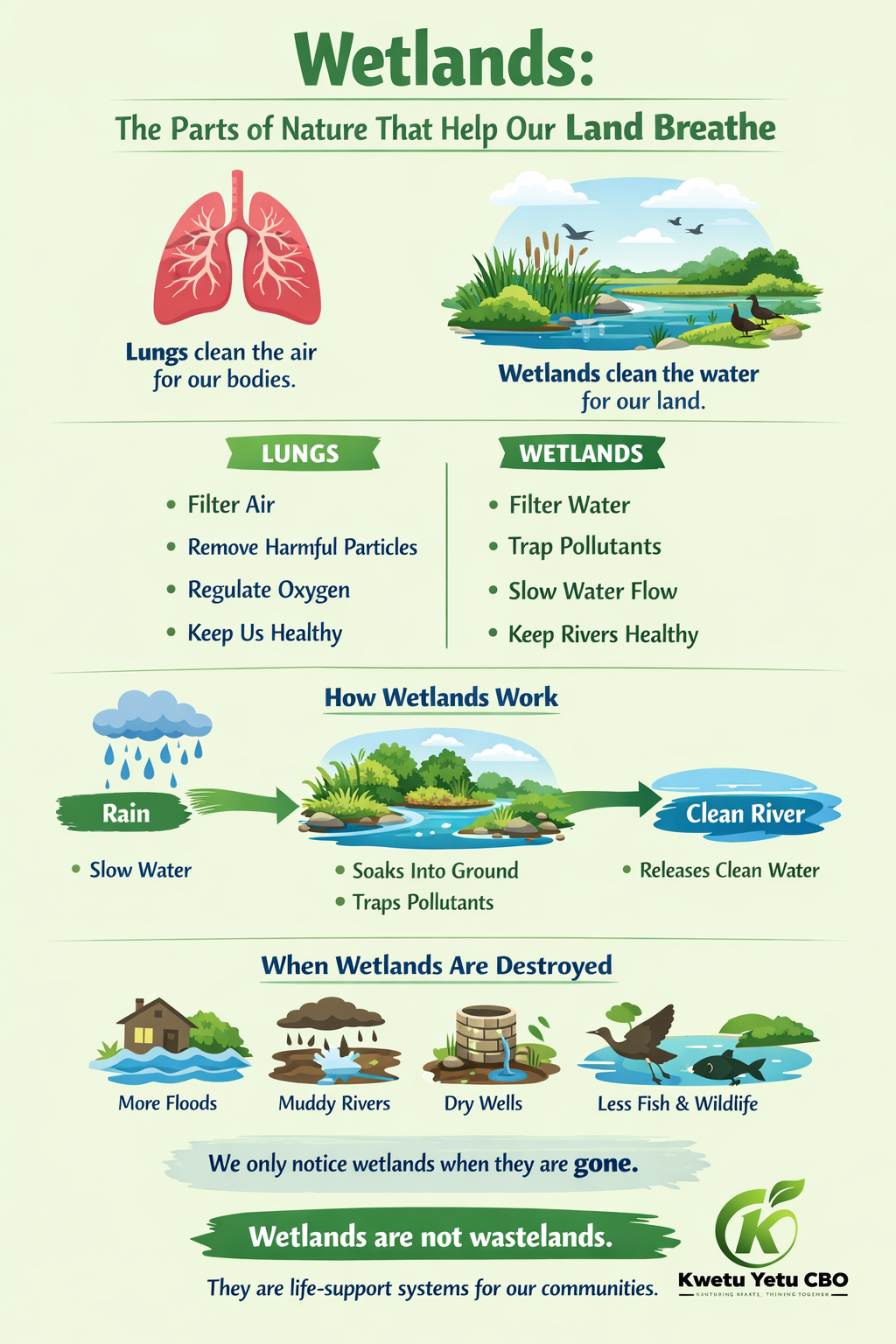
They are like the respiratory system of the landscape.
Just like lungs clean the air we breathe, wetlands clean the water that moves through our land.
How Wetlands Help Water Soak into the Ground
When it rains in areas with wetlands, water does not rush straight into rivers.
Wetlands slow down the water.
This allows:
• Water to soak into the soil
• Groundwater to be recharged
• Less surface runoff
• Reduced flooding downstream
Without wetlands, rainwater flows very fast across the land. This causes erosion, floods, and loss of soil, and very little water enters the ground.
How Wetlands Clean Water Naturally
As water passes through a wetland, a natural cleaning process happens:
• The slow water allows mud and dirt to settle
• Wetland plants trap particles with their roots and stems
• Tiny living organisms in the soil break down pollutants
• Harmful nutrients and chemicals are absorbed
• Toxins are trapped in the soil before reaching rivers
By the time this water leaves the wetland, it is much cleaner.
Just like lungs filter air before it reaches the body, wetlands filter water before it reaches our rivers and wells.
Wetlands Help Prevent Floods and Drought
You can think of wetlands as the land breathing in and breathing out.
• During heavy rains, wetlands absorb water
• During dry periods, they release stored water slowly
When wetlands are destroyed, water has nowhere to go. It rushes through communities as floods. Later, during dry seasons, there is not enough water stored in the ground, and people experience drought stress.
Why We Don’t Notice Their Importance
Wetlands work quietly.
We only start to notice their importance when:
• Floods become frequent
• Rivers become muddy and polluted
• Wells start drying up
• Fish and wildlife disappear
At that point, we begin spending money trying to fix problems that wetlands were solving for free.
Just like oxygen in a hospital.
Wetlands Are Not Wastelands
Wetlands are not useless land.
They are life-support systems for our environment and our communities.
They clean water.
They control floods.
They store water.
They protect our future.
Protecting wetlands is not just about conserving nature.
It is about protecting the natural system that helps our land — and our communities — breathe.